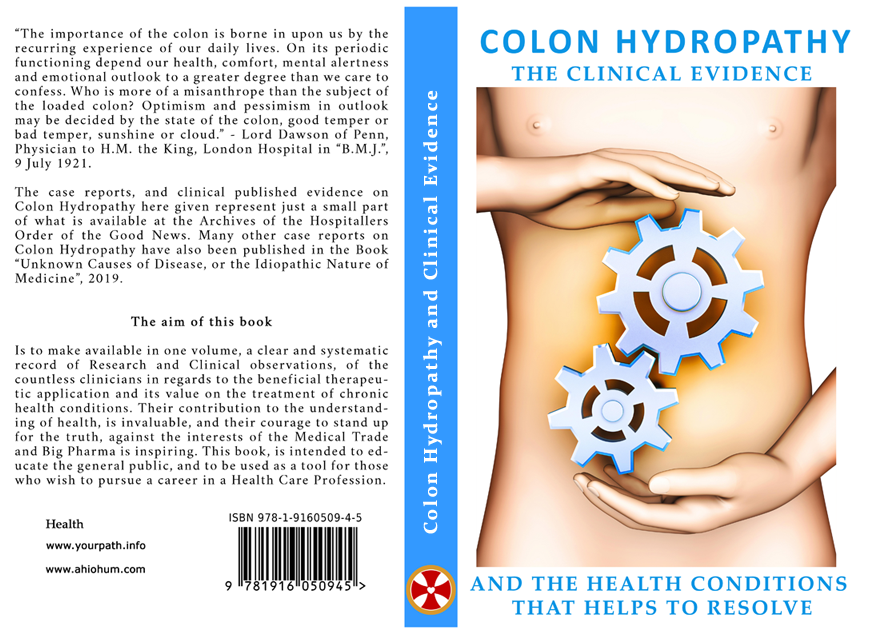
Colon Hydropathy: The Clinical
Evidence, And The Health Conditions That It Helps To Resolve
First Edition October 2020
ISBN: 978-1-9169599-4-5

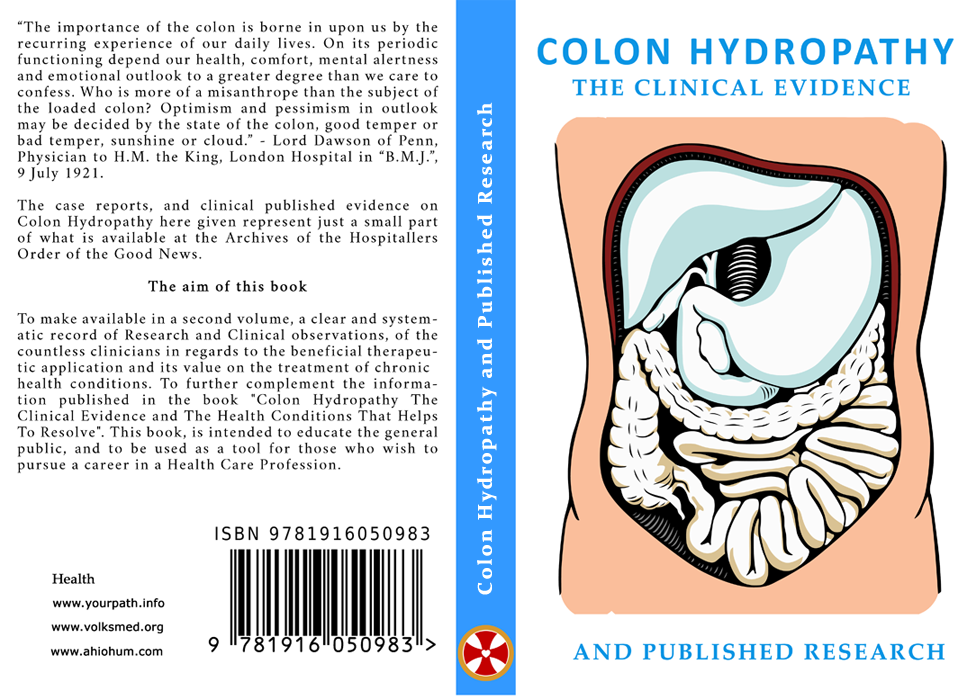
Colon Hydropathy: The Clinical
Evidence, And Published Research
"Educating not medicating"
First Edition October 2028
ISBN: 978-1-9160509-8-3
List of Published Books
Colon Hydropathy: The Clinical Evidence and
The Health Conditions That Helps To Resolve Vol.1
Colon Hydropathy: The Clinical Evidence and Published Research
Vol.2
Colon Hydropathy: The Clinical Evidence and Published Research
Vol.3
Concerning Trauma a Major Factor in the Causation of Disease
Bicarbonate of Soda in the Treatment of Disease
Toxaemia: The Principle Causation of All Organic Disease,
Clinical Findings & Research
Concerning Stasis - A Major Factor in the Causation of Disease:
And Drainage as a Factor in Resolving Disease
Medicine: Lies, Greed &
Death, How the Food Industry and Medicine are Killing You
(PDF)
The Nescience of Medicine: Includes COVID-19 THE UN-TOLD STORY
Part 2
Covid-19 On Trial - Critical Analyses of a “Pandemic”: includes
Covid-19 The UN-told Story Part 3
Medicine From Bad Pharma To Bad Science: Includes Covid-19 The
UN-told Story Part 4
Medical Trade Exposed: It's Lies, Atrocities and Deceit:
Includes Covid-19 The UN-Told Story Part 5
False Prophets of Covid-19
Emunctology: Principles and
Foundations of the Emunctory System (PDF)
Emunctology Reference Manual
The State of the Blood in the Causation of Disease
Hydropathy: The Principles and Foundations
Clinical Nutrition: Principles and Foundations
Sugar Sweet Little Poison: The Untold Story of Processed Refined
Sugar, The Greed, The Lies and The Diseases
Vision the Eye Story
Vaccines The Precursor To
Ill Health & Death (PDF)
VIRUSES The Elusive 100 Year Search for the Missing “Viruses”,
Or The Farce And Fraud of Virology Explained in Detail
(PDF)
Videos on the Medical Trade
Dr David Rasnick, PhD,
Scientist, in “AIDS to COVID”, 2 November 2025 -
Video
In 1978, David Rasnick was 1 of 2 PhDs hired to set up the
chemistry group in the Diagnostics Division of Abbott
Laboratories in North Chicago.
In 1996, he left pharma/biotech to join dR Peter Duesberg,
Professor University of California at Berkeley, to exposed the
HIV fraud.
Mammograms Cause Cancer
- Video
Footage Of Aberrant Cells Post Ultrasound -
Video
Report was televised by CNN in 1983; research findings were
reported in "Fetal Effects of Ultrasound: A Growing
Controversy”, Journal of Nurse Midwifery, July/August 1984.
El Poder de las
Farmacéuticas - Video
Las Farmacéuticas y su Poder
en el Mundo - Video
Fluorine and Fluoride: Entirely
Different
Fluoride 2025 - Video
The Fluoride Deception
- Video
The Element From Hell
- PDF
Fluorine and Fluoride Are
Entirely Different. Here's Why - PDF
Medical Trade Poisonous Synthetic
Pharmaceutical Psychiatric Medication
Movie "55 Steps" (2017)
https://tel.yandex.ru/video/preview/8846761518113467743
CDC Vaccine Schedule In Utero
to 12 Months

Medical Trade Vaccines
Dr Mary Talley Bowden, MD
on Flu Vaccines - Video
The Medical Trade is Lying
Vaccine - Video
To Vaccinate the World
- Video
Higher Mortality rate in
Vaccinated infants than unvaccinated - Video
Polio and DDT - Dr Suzanne
Humphries, 2013 - Video
Deaths After Vaccination
Taiwan October 2021 - Video
Deaths from Vaccines 5 May
2021 - Video
Vaccines in Foods
- Video
Vaccines Cause Sudden Infant
Death Syndrome - Dr David Davis MD - Video
American Nurse Speaks on
Covid-19 Vaccines 2022 - Video
Neurological Toxin in
Vaccines - Video
Facial Palsy From Vaccines
- PDF
Nurse With a Conscience
- Video
Medical Trade Forced Vaccinations
1.
Forced Vaccination by the Medical Trade on Children
(USA) - Video
In this video is a child being
given 6 vaccines in a single day by the Medical Trade with the
consent of the parents.
This to say the least in any sane civilization should be seen as
criminal.
2.
Forced Vaccination by the Medical Trade on First Day New Born
Babies (Argentina) - Video
In this video the Medical Trade
Clown is threatening the Parent that the new born baby has to be
vaccinated, then calls the police to take the baby by force and
vaccinate the new born.
Food Industrial Complex
Aspartame Sweet Misery
- Video
The Truth About Seed Oils
FED A LIE - Video
How L'Oreal Poisoned the
World - Video
“Doctors are misinformed, patients are misled,
and millions of people are taking medication with no
benefit for them.”
More
than
1
Billion prescriptions are dished out in the UK each year,
which is 2.7 Million per day or 1,900 every minute, an
increase of nearly 2/3 in just a decade. And the
increasingly widespread use of prescription
medication can have some serious consequences. Most
people are aware that the over-prescription of
antibiotics has unfortunately led to the development of
resistant strains of bacteria and many people are
campaigning for more restrained prescription of
antibiotics. However, an interview with Aseem Malhotra,
a London-based cardiologist, reveals that the problem is
by no means limited to antibiotics; in fact, there is a
worrying trend in the over-prescription of drugs for all
sorts of ailments, leading to ever increasing costs of
side effects. He explains that this is due to
misinformation at all levels in the system, from how
research into drugs is funded, to how it is reported in
academic journals, to how their pros and cons are
presented to patients. Aseem Malhotra, who trained as an
interventional cardiologist, practices in London and is
a former consultant clinical associate to the Academy of
Medical Royal Colleges. Last year he became the youngest
member to be appointed to the board of trustees of
health think tank The King’s Fund. He has campaigned for
years on a number of issues including transparency in
health care, fighting excess sugar consumption and
criticising the focus on total cholesterol and use of
statins. He spoke to us about what he calls “an epidemic
of misinformation” that has led to people undergoing
unnecessary treatments. The BBC programme
The Doctor Who Gave Up Drugs has recently brought
the issue of prescription drugs back into the limelight,
highlighting how prescription of drugs has increased
massively in the last five years especially, for
example, prescription of painkillers (up by 25%) and
antidepressants for teens (up by 50%). It also presents
the alternative to this, one that Malhotra is also
endorsing and led on, that other treatments such as
lifestyle interventions like diet and exercise can be
just as effective, if not more so, than drugs. It is
important to take a holistic approach to health, but the
culture of medicine at the moment means that people
simply want a miracle pill to solve all their problems,
or “a pill for every ill” as Malhotra called it.
Bias in Funding for drugs research
So
let’s look at the issues that Malhotra brings up with
what he calls “a collective system problem”. Firstly,
there is bias in the funding of drugs research. A great
deal of funding comes from pharmaceutical companies who
stand to gain a profit from the industry. The way they
make the most profit is to create drugs that can be used
by the largest number of people for the longest amount
of time, which clearly means that they aren’t
necessarily funding research that is the most beneficial
to patients. It also means that most of the new drugs
produced in the last 20-30 years have been near copies
of existing drugs, with just tiny alterations, meaning
that the clinical advantages of these drugs over what
was already available is minimal. A Barral report on all
internationally marketed drugs between 1974 and 1994
found that
only 11% were truly innovative and multiple
independent reviews since then have also concluded that
around 85-90% of all new drugs provide few or no
clinical advantages to patients. On top of this, many of
these drugs also have serious side effects, which have a
negative impact on people’s health.
Biased Reporting in medical journals
Another
serious issue in the chain, that Malhotra points out, is
bias in the reporting of drugs research. Firstly, there
is a publishing bias whereby only the “success stories”
even see the light of day, but even within these
supposed “success stories” there can be misleading
information. For example, the reporting of risk can
mislead a reader, which is seen even in well-respected
journals like The Lancet, the BMJ and JAMA. Between 2006
and 2009, around
1/3 articles published in the three aforementioned
journals had mismatched framing, which means that
they report the benefits of a drug in relative risk
(large numbers), whereas they report harms in absolute
risk (small numbers). For example, take a drug that
reduces your risk of getting heart disease from 10 in
1000 to five in a 1000 – it would be reported in
relative risk as a 50 percent reduction. However, the
drug also increases your chance of getting intense
muscle pain from five in 1000 to 10 in 1000, but this
side effect would be reported in absolute risk, as an
increase of 5 in 1000, so 0.5 percent increase. This is
an obvious misrepresentation, yet it is permitted and
used extensively in trusted journals. These are then
used as marketing tools by the pharma companies, who pay
for reprints of the journal. Doctors trust these
journals and very rarely question what they say and
their recommendations for patients will reflect this.
For Malhotra: “The best way I can give quality care to
my patients is to have complete transparency”, which
means he has started telling patients the absolute risk
involved with the drugs on offer and he reports that
they are often underwhelmed by the benefits of these
drugs when given this information. These medical
journals have also been found to print “bad data”. For
example, a study investigated Riveroxaban as an
alternative for Warfarin, a widely-used anticoagulant.
It concluded that this drug had the benefit that, unlike
with Warfarin, the blood does not have to be regularly
checked. This is a major inconvenience avoided for
patients, so the NHS spent around £50 million on this
new drug. However,
an investigation by the BMJ uncovered that a device
used in the randomised controlled trial that justified
the NICE guidelines recommending the drug, a key
measuring instrument had been faulty, which casts doubt
on the whole trial. Even though this has all come out,
doctors up and down the country will still be
prescribing this drug to patients because releasing an
investigation in a journal does not guarantee that every
doctor will both hear of this and change their behaviour
accordingly, as ultimately doctors still follow NICE
guidelines, which take a while to change. The conflicts
of interest in research can even result in serious
scientific fraud and manipulation of statistics.
GlaxoSmithKline paid the largest fine in US history for
fraud, $3 Billion, in 2012 specifically for illegally
marketing drugs, misreporting and hiding data on harms.
However, during the period covered by the settlement
they made $25 Billion in profit from the drugs. No
one went to jail, no one went out of business and
the cycle continues. And within academic
institutions, even when fraud is revealed, often no
one is punished. People are extremely unwilling to speak
out against ‘Big Pharma’ because that is how their
research is funded and they are scared that if they
speak out they will lose this funding. Malhotra
summarised: “Doctors are unwittingly becoming part of a
system where side effects are underreported and
institutions are funded by pharma so people don’t speak
out when they should.”
The Problem with Medicating
This
leads us on to the next point to address which is – what
is so wrong with over-medicating? Well, adverse side
effects of prescription drugs are now having a serious
impact on the healthcare system, with about a
quarter of hospital admissions of the elderly being due
to negative reactions to prescription drugs. FDA figures
in 2014 indicated that in the US there were about
123,000 deaths due to adverse side effects of prescribed
medication that year, a number that tripled in a decade,
and there were around 800,000 serious disabilities
caused. This is likely due to the fact that when drugs
go through clinical trials they are usually tested on
the young and fit, with only one drug at a time. Many
elderly people are frail and taking multiple drugs at
once, which can react against each other. The chemical
compounds used in these drugs are all very complicated
and may react with each other in unpredictable ways, but
these are not comprehensively tested in trials, because
it would be impossible to test every combination. This
means that patients are essentially guinea pigs when
taking multiple drugs at once. What’s more, new
drugs are being brought out all the time so we cannot
know what the long term side effects of these will be or
how they will interact with other drugs. And often the
side effects of drugs are combated with… simply taking
more drugs. For example, a patient may take a sturdy
painkiller to help with joint pain, but this drug has a
side effect of churning up their stomach, so they take
another drug to settle their stomach. However, the most
“unnecessary” medications according to Malhotra
are the so-called “preventative medicines” like statins.
Statins only slightly reduce the risk of heart attack
and have been shown to cause Type 2 diabetes in 2% of
patients. The other issue with preventative medicine is
that it is detracting from the importance of lifestyle
choices. People think that they can take a pill such as
one to lower cholesterol and that means that they can
eat an unhealthy diet as they are ‘covered’ by the pill.
The reality is that a cholesterol-only pill is probably
not giving much benefit to them and eating burgers and
chips every day will cause them serious harm, so they
are getting a net harm from this attitude. In general,
lifestyle is sorely overlooked, partly because GPs only
have 10 minutes with each patient and it is easier to
prescribe a pill than it is to explain the importance of
healthy diet and exercise, and partly because people
just don’t want to hear it. However, Malhotra says:
“When you actually tell people the truth about how
beneficial lifestyle is against medication they are
amazed.” Part of the solution to this crisis of
overmedication is to actually actively take people off
their medication, as seen in The Doctor Who Gave Up
Drugs, as well as being careful when starting
someone on a medication. Sometimes when people have been
taking a drug for a long time they become accustomed to
how it makes them feel; they don’t even realise that the
reason they are feeling fatigued, depressed etc is
because of the drug. When they stop taking it sometimes
they suddenly feel a new lease of life without the side
effects bringing them down. Malhotra claims that this is
the case with statins. He said: “The original data
suggested that only 1 in 10,000 people get any
significant side effects, which is an absolute joke… in
my view its at least 1 in 5 that will at some point
experience a side effect that interferes with quality of
life.” Anti-depressants are also being prescribed more
and more and whilst this is in part due to greater
awareness around mental health, it is also because
therapy is more expensive, so it is easier for GPs to
simply prescribe a drug to help people suffering from
mental illness. However, it is important to also
consider and properly weigh up possible
non-pharmacological interventions like cognitive
behavioural therapy, or even something like a support
group, as each person is different and anti-depressants
may not work for them. This is most likely to be true
for people whose illness stems from a trauma or
something in their past that needs to be addressed by
talking about it and cannot get better without resolving
their issues. Considering the importance of lifestyle is
important both individually for patients’ health but
also in terms of public health initiatives to improve
the health of the population. In fact, most of the
increase in life expectancy seen in modern times has
been due to public health interventions. Around 25 of
the 30 years improvement in life expectancy has been due
to things like safe drinking water and sewage disposal,
safer workplace environments, washing hands, smoke-free
buildings, seatbelts in cars etc. Most of the further 5
years have been down to emergency treatments such as
antibiotics for infections. However, this is not where
the companies make their money – preventative medicine
like statins is where the profit lies. And whilst
public health interventions have clear benefits they are
not given the attention they deserve – but Aseem
Malhotra is fighting against that. He is one of the
original founding members of
Action on Sugar which aims to reduce people’s sugar
intake by educating people on the effects of sugar and
he also endorsed the sugar tax. So to answer the
question ‘what is wrong with overmedicating?’ – on top
of the issue of side effects we have the inconvenience
of taking a pill every day, possible interactions with
other drugs, cost for the NHS, the attitude that taking
a drug means that a change in lifestyle is not
necessary, possible dependence on the drug, possible
bias in reporting of research meaning the side effects
are more significant than you may be aware of (I could
go on!). And either way, the issue is largely about
transparency and giving the patient the right to make an
informed choice on their health.
Transparency in health care
This
brings me on to how information is being portrayed to
patients when deciding what treatments they receive. If
people are not receiving the correct information on
treatments, they cannot make informed decisions about
their own health. And this is not just limited to
prescription drugs either – people are currently
undergoing surgeries that may not even be necessary. For
example, when a patient is having a heart attack they
will undergo surgery to save their life and the odds for
this being the beneficial course are very good. However,
when it comes to heart surgery (stenting) for stable
coronary heart disease it is a different story. Whilst
1/3 of people with heart disease in the UK will undergo
stenting for stable angina, this procedure will not
prevent a heart attack or prolong life. It does help to
relieve symptoms, although usually these can also be
relieved with the appropriate use of drugs without the
need for an invasive operation in which there is a 1%
chance you will have a heart attack, a stroke or die.
However, the most troubling aspect of this is that
88% of patients, when asked, thought they were having
the procedure to prolong their life and prevent a
heart attack, which is does not do. This means that the
true nature of the procedure is not being accurately and
comprehensively explained to the patients. Perhaps if
they knew that the only benefit was symptom relief they
would still want the operation, but perhaps not. What is
important is that they get the informed choice. This is
not just limited to cardiology either – the same can be
said for orthopaedics and many other areas. Malhotra
told us how multiple orthopaedic surgeons had told him
that that is they had the same problem as some of their
patients, they would not have chosen to undergo the
treatment that they themselves had performed. This is
partly due to a culture of doctors wanting to be seen to
be ‘doing something’, but also the way in which people
and hospitals are paid. Whilst here in the UK there is a
“payment by results” system, there is also an element of
“payment by activity” as allocation of funding to
certain hospitals are affected by what procedures are
carried out at those hospitals. This gives an incentive
for institutions to carry out many procedures, even if
it is against their better judgement. Despite this
plethora of issues relating to drugs research and the
communication of the facts, there is very little written
in the media about such things and where it does it
tends to simply perpetuate the perception and culture
about more pills being necessary. One example which
breaks away from this trend is a campaign by the Academy
of Medical Royal Colleges, which Malhotra was lead
author on in a research paper published in the BMJ,
called ‘Choosing
Wisely: Winding back the harm of too much medicine’,
which was covered relatively successfully in the media.
It encouraged patients to ask questions such as “How
much benefit am I getting?”, “What are the
alternatives?” and “What happens if I do nothing?”. It
also encouraged doctors to try and revaluate their
practice and only use interventions that are fully
supported by the evidence.
There are many patients in the UK and abroad
that are taking medication With Little or No Benefit
that could be Causing Harmful Side Effects. In
the US, about 1/3 of all healthcare activities bring
absolutely no benefit to the patient. Whilst this is
likely worse than over here because theirs is a
commercialised system and based even more on activity
over results than it is here, we still have a massive
problem to address. If we take a step back and have a
more sensible distribution of resources, where we divert
attention away from drugs that cause side effects and
just bring patients back to the doctor, we can focus on
elements that would really benefit people like providing
better social care. A more idiosyncratic approach to
medicine is also warranted; every individual is
different and has different priorities. Some people may
hear the truth about certain drugs and still want to
take them and other may hear it and want to keep well
away. It is about giving people the information and the
choice to make their own decisions about their health.
Malhotra film documentary called
The Big Fat Fix,
which gives a positive message about the impact of
lifestyle on health.
Twitter
@DrAseemMalhotra Website:
doctoraseem.com
Article by Abbie Llewelyn, in
Volteface, 10 November 2017.
Medication Singulair Causes
Depression and Suicide - Video
Cannabidiol (CBD) oil,
high in Tetrahydrocannabinol (THC)
DOSAGE INSTRUCTIONS
It
usually takes the average person about 90 days to ingest the
full 60 gram or 60 ml oil treatment. I suggest that people start
with three doses per day, about the size of a half a grain of
short grained dry rice. The patient should take this dosage
every 8 hours, early in the morning, then again in the afternoon
and then they should take their final dose of the day, about an
hour before bedtime. It should also be noted that as a
patient begins to ingest this oil, the patient does not normally
feel the oils effects until about an hour after they have taken
their dosage, so please be aware of this fact. A beginner’s dose
such as I am describing would equal about ¼ of a drop.
After
four days at this dosage which should be taken three times a
day, most people are then able to increase their doses by
doubling the amount of their dosage every four days. By
following this simple procedure, many patients have reported
that they felt that they had not experienced the high, which
this oil can cause. But in truth no two of us are the same and
we all have different tolerances, so some will be able to up
their dosages more quickly than others. In reality, even if one
does become what is commonly referred to as being high this will
not harm them in any way, if the oil they are ingesting was
produced from the sedative strains of Indica, which I recommend
and the resulting oil was produced in the proper way.
It
takes the average person anywhere from 3 to 5 weeks to get to
the point where they can ingest 1 gram or 1 ml per day.
Once they reach this dosage they can continue at this rate until
their medical issues are brought under control. This means that
after the patient has become accustomed to the oils use, each
dose they are ingesting will equal 8 to 9 drops every 8 hours
and in many cases, I have seen patients that have had no trouble
ingesting even far more. It takes a dosage roughly the size of
two grains of short grained dry rice to equal one drop, so once
the patient has become accustomed to the oils use they are
actually ingesting doses which equal 16 to 18 grains of rice per
dose. In some cases I have even seen patients who had no fear of
this medication, ingest the full 60 gram treatment in one month
and after doing so, many of them were declared to be cancer
free. By using the method which I am describing, it allows your
body time to build up a tolerance for this medication slowly and
once the patient becomes accustomed to the oils effects, most
patients actually report that they enjoy taking it. We
all have different tolerances for any medication and your size
or body weight has little to do with your tolerance for hemp oil
and even children can take the same dosage as adults, with no
detrimental effects.
WARNING
ABOUT THE USE OF THIS MEDICATION WHEN USING OTHER DRUGS
We are not
medical doctors, so for any questions regarding the use of
Cannabidiol (CBD) oil, high in Tetrahydrocannabinol (THC),
alongside various pharmaceuticals please consult a medical
doctor who supports the use of medical cannabis and who has
experience with it. Be aware when commencing treatment
with hemp oil that it will lower your blood pressure,
so if you are currently taking blood pressure medication, it is
very likely that you will no longer require its use. Often
patient’s will try to continue using their blood pressure
medication, but if it is taken along with the oil their combined
effect, can bring the patient’s blood pressure down too
uncomfortable levels. It’s a good idea for those beginning
treatment with the oil, to check their blood pressure often and
then reduce their intake of other blood pressure medications as
their blood pressure levels reduce. In the event that a patient
is already suffering with low blood pressure, I have had reports
from people who have this condition and they stated that simply
drinking some water when they began to feel uncomfortable did
help to some degree. Those who have low blood pressure, may in
some cases find it necessary to ingest even smaller doses of
this medication and to increase their dosages accordingly. But
since this medication really does not present a danger, I think
that their bodies will adjust to the oils effects in a short
time, after which they should experience little or no difficulty
with its use. Diabetics should also be aware
that they will usually find that their need for insulin will be
reduced and it may even decrease to the point, where they will
no longer require its use at all and the same goes for most
other pharmaceuticals as well. Diabetics are diagnosed with
type1 or type 2 diabetes and no matter what type you suffer
from, it is still beneficial to use this oil because not only
will it decrease your need for insulin, it will also protect
your body from all the other harm this disease can cause. Also,
please be aware that when the patient takes Cannabidiol (CBD)
oil, high in Tetrahydrocannabinol (THC) many people find if they
are using any pharmaceuticals such as steroids /
painkillers / morphine it makes horrible side effects
when mixed, so many people reduce their medications by half on
day one – then reduce and stop the medications over 7 to 14 days
– mixing the medications with the oil can produce undesirable
side effects – the symptoms / side effects of the medications
can be exacerbated. The main conditions / medications we warn
about are the heart, blood pressure and diabetes and to closely
monitor the levels over 3 months or so.
INGESTING YOUR DOSAGES
Many people
today are suggesting that patients should be placing the dosage
they are ingesting under their tongue, or they should be
sticking their dosage to their gums, which is now known as
tacking. Although methods such as this can get the medicinal
cannabinoids into the patient’s body, I really do not agree with
these methods because oils can often have a bad taste that can
linger in the mouth for quite some time. I feel that by simply
placing the dosage in the patient’s mouth, would have
benefits for those who have gum infections and problems of this
nature, but in most cases I believe that their dosage should
just be swallowed. The proper oil is a thick grease
like substance, so when I ingest my dosage I simply put it on my
finger and then place it on my teeth, after which I drink cold
water and then use my tongue to remove it from my teeth and then
I swallow. By using this method, I can usually take my dosages
without hardly tasting the oil at all and I think that most
patients would prefer to do the same, but there are also other
simple methods which can be used to avoid the bad taste. The
patient’s dosage can be placed on a small piece of bread and the
bread can then be folded over to cover the dosage and then it
can be placed in the patient’s mouth and swallowed much like a
pill with water. Another good method to avoid the taste, is to
place the dosage between two thin slices of fruit such as
bananas and then place it in the patient’s mouth so it can be
swallowed as well. If the oil is produced properly, often it
really does not have an unpleasant taste that will linger, but
the simple methods I have described should help patients ingest
their dosages more easily. The name of the game, is to simply
get the oil into the patient’s body in the easiest and most
pleasant way possible, so I think following the methods I have
described should be given serious consideration.
SUPPOSITORIES
For quite some
time now, many people have been showing an interest in using
this medication in suppository form, because they think that by
doing so they can avoid becoming high and for some, this might
be somewhat true. I have used this oil in suppository form
myself, but when I took quite a large dose in this manner I
cannot say that I did not feel its effects. I actually think
that in some cases using suppositories is a very good idea,
since I believe the oil should be placed as close as possible,
to the medical problem which is being treated. Therefore,
for someone who is suffering with something such as prostate or
bowel cancer, I believe that it could be more beneficial for
their medical problems, to use the oil in this manner.
But still, I have seen many patients with these same medical
disorders, heal themselves by simply ingesting their dosages by
mouth, so I will leave the method you wish to use up to you.
When the oil is used as a suppository, the medicinal
cannabinoids this oil contains go directly into the blood stream
by passing the liver. But for those who are suffering
with such things as stomach or liver cancer etc. I believe that
it would be more beneficial to ingest the oil by mouth. If you
intend to use suppositories to treat your medical problems, then
the suppositories should contain the same amount of oil, you
would normally ingest by mouth and the dosage should be
increased in the same manner. Suppositories are fairly
simple to prepare, but one should be careful about how
much oil they contain, so in the beginning it may take some
effort on your part to get the dosage right. Usually drug stores
will supply suppository molds and all you have to do, is use a
substance such as shay butter and then apply heat until it
becomes a liquid, at which point you can add the oil and then
fill the molds. It’s a good idea to put the molds after being
filled in a refrigerator, to allow the substance they now
contain to harden up and after doing so, the suppositories are
then ready for use. In addition, drug stores can usually supply
empty gel caps and the patient’s dosage can be put into the gel
caps and then used as a suppository or can be taken by mouth,
the gel cap will then disintegrate leaving the oil where you
need it to be placed. As I stated I do think that suppositories
do have their uses, but I find this method to be quite time
consuming and one must be careful about the amount of oil being
added, so I still prefer to take my doses by mouth. It should
also be mentioned that this oil has many anti-aging qualities
and it can also rejuvenate vital organs. So don’t be surprised
if the patient who is using it, begins to look a bit younger and
any other problems they were having with their kidneys or other
vital organs could simply disappear as well. When people
are ingesting the oil, I like to see them stay within their
comfort zone, but the truth is, the faster you take the oil the
better your chance of surviving, if you are suffering from a
serious condition such as cancer.
MAINTENANCE DOSES
At the end of
their treatment most people continue taking the oil, but at a
much reduced rate. About 1 to 2 grams a month would be a
good maintenance dose, just a drop or two at night
before bedtime is all that is generally required to maintain
good health. Often I am asked if this oil must be taken with
food, but from my experience it seems to make little difference,
so I will leave that for the patient themselves to decide. I
feel that there is little need in most cases for anyone to
overdose on the oil, unless they actually have a life
threatening condition such as stage 4 cancer, which is putting
their life in danger and they wish to bring this disease under
control more quickly. Even in cases like this, it is usually not
necessary to take overdoses but if one chooses to, then I really
have no problem with them taking the oil in excess. Since in
reality, unlike many pharmaceutical medications which our
medical systems supply, an overdose of hemp oil really does not
do any harm and cannot bring about your death. The main
side effect of this medication is sleep and rest, which
plays a very important role in the healing process. Usually,
within an hour or so after taking a dose, the oil is telling you
to lay down and relax. Don’t try to fight the oils sleepy
effects, just lay down and get comfortable, then allow the oil
to give you the rest and relaxation you require to heal
properly. The effects of the oil may cause your mind to wander a
bit and often patients will be somewhat unsteady on their feet
when they begin to use this medication. But as the patient
builds up their tolerance, these effects will diminish quickly.
Usually within 3 to 4 weeks, the daytime tiredness associated
with this treatment after the patient takes their dosage just
fades away, but the patient continues to sleep very well at
night. I also suggest that patients should not try to
drive their cars, until they become more accustomed to
the oils effects, after which they are then able to drive safely
once more. Once you become used to the oils effects it does not
impair your ability to drive in any way, because unlike alcohol
and many pharmaceuticals, this oil does not impair your motor
skills.
DISCONTINUING THE USE OF DANGEROUS ADDICTIVE PAIN MEDICATIONS
The only time I
would recommend that people start out with larger doses, would
be if their life was really in danger or to get them off
addictive and dangerous pain medications, supplied by the
medical system. When patients begin the oil treatment and they
have been using these addictive medications to alleviate the
pain, they usually cut their pain medications in half and they
will also probably find that they no longer require the use of
most other pharmaceutical drugs as well. Many dangerous pain
medications like hydro morphine are very addictive in nature and
patients, will have a hard time ceasing their use due to the
withdrawal symptoms they will suffer, because they have become
badly addicted to these substances. The oil will allow patients
who are ingesting it, to suffer much less withdrawal symptoms
from the medications they were using and it can usually replace
the use of these dangerous medications in 2 to 3 weeks and often
even less time is required. The object is to ingest enough oil
to reduce the pain and to help the patient, get off these
dangerous medications as quickly as possible. For the most part,
pharmaceuticals are little more than toxins anyway and once the
patient begins ingesting the oil, often the presence of these
toxic drugs can begin to give them stomach problems. This is
caused because the oil recognizes these chemicals and poisons
for what they really are and the oil wants to expel them from
the patient’s body. Once the patient stops ingesting these so-
called drugs, their stomach problems will then just disappear
and in most cases they will find that the only medication they
really require is the oil. For those who are suffering from
terminal cancer, the oil will either cure their cancer or in
cases where it is too late to affect a cure, the oil will allow
them to experience little or no pain and at least then they can
die with dignity. Even if a patient has been given only a short
time to live by the doctors, do not think of their situation as
being hopeless, for very often the oil is still able to bring
them back to a state of good health. If the cancer
cannot be reversed with the use of this oil, it is not unusual
for the patient to live on for many month’s longer than expected
and during that extra time the oil gives them, they often can
experience a very good quality of life.
DOSAGE
INSTRUCTIONS FOR THOSE WHO HAVE BEEN DAMAGED BY CHEMOTHERAPY AND
OR RADIATION ETC.
Hemp
oil has a very high success rate in the treatment of all forms
of cancer and now there is no shortage of testimonials
available on the internet, from individuals who have used this
oil successfully to do just that. But unfortunately, many people
who came to me seeking help, had already been badly damaged from
the chemotherapy and radiation treatments the medical system
supplied. The damage such treatments can cause have a lasting
effect and people who have suffered the effects of such
treatments are the hardest to cure. But even those who have
suffered all this horrible damage to their bodies, still have a
good chance to make a full recovery, if they follow my
instructions. When those who have been damaged from these
so-called treatments ask for my advice, I tell them to ingest
180 grams or 180 ml’s of high quality oil, as quickly as they
can and this will give them the best chance to survive.
The extra 120 grams or 120 ml’s that I advise them to ingest, is
needed to undo all the damage that these horrible treatments
have left behind in the patient’s body. Once the
patient has become accustomed to the oils use, they should not
encounter any problems ingesting 180 grams or 180 ml’s in 5 to 6
months and often they can even accomplish this much more
quickly. Medicine today is much more about money than it is
about healing and this statement can be proved, by simply
looking at the insane treatments that doctors tend to employ, in
the treatment of serious conditions such as cancer. Both
chemotherapy and radiation are well known to cause cancer,
so in reality doctors are giving patients who are suffering from
cancer, treatments which will cause the very disease they say
they are trying to cure and often these horrible treatments,
will help to spread the cancer to other parts of the patient’s
body. It is true that these treatments can kill cancer cells,
but while they are doing so they often kill the patient as well.
Even if they do not kill the patient immediately, the effects
from these treatments can allow the cancer to spread and in the
end, this often brings about the patients demise. Usually when
these absurd treatments have failed the patient is said to have
stage 4 cancer and at that point doctors tell the patient that
there is nothing more that they can do to help and the patient
is then sent home to die. But the doctors are usually happy to
supply them, with vast amounts of dangerous and addictive pain
killers until their death takes place. Because I expect that
doctors only look at this, as being good for business. If all
this does not sound like insanity to you, then what else could
it be called and why do doctors employ the use of such things as
CT and PET scans etc., when the radiation the patient is exposed
to from these scans, can cause cancer as well? In addition, from
what I have learned it seems that most oncologists will not
expose their bodies to the same treatments which they supply to
us, if they were suffering from cancer themselves. So why do you
suppose they would refuse these treatments themselves, when they
seem to feel so free in providing the same treatments to us? Do
you think that it could possibly have something to do with money
and the fact that they already know the treatments they have
been using do not work? It appears that our trusted doctors
still have a great deal to learn about the art of healing, so if
you are suffering from a serious condition such as cancer. I
think that it would only be wise to put your faith in a natural
medication, which has already been proven to work effectively
and harmlessly. If it sounds as though I have no faith in our
current medical systems, to treat most serious conditions
properly that would be quite correct and I don’t believe that
anyone who is thinking rationally, could disagree with the
statements I have made. Properly produced hemp medicine is the
greatest natural healer on this planet bar none. Once you
experience what this medication can do, you will come to
understand why both history and I call hemp medicine a cure all.
TREATING SKIN CANCER
If you can acquire a small quantity of properly produced oil, it
will definitely work to treat skin cancer effectively and
usually it only takes a few grams of this oil to accomplish the
task. Grow or purchase some good high quality bud from sleepy
sedative strains of Indica, which have a THC content of 20% or
more. Then take about 30 grams of this bud and produce the oil
from it, following my instructions which I have made available
on my website phoenixtears.ca. It should also be
mentioned that in the treatment of skin cancer, oils produced
from Sativa strains can be used effectively as well, since when
applied topically the patient does not experience its energizing
effects. This amount of starting material should
produce 4 to 5 grams of high grade oil. Apply the oil to the
skin cancer and cover it with a bandage, apply fresh oil and a
new bandage every 3 or 4 days and the cancer should soon
disappear. I always tell people to continue treatment until the
cancer is gone, then they should continue to treat the area for
about two more weeks just as if the cancer was still there, for
this will eliminate any cancer cells which could still remain
Doing this will ensure that all the cancer cells are dead and I
have never seen a skin cancer return if my instructions are
followed. If you’ve had skin cancer for quite some time and the
cancer is well established, it may take some time to cure. But
usually even in quite severe cases the cancer will disappear in
less than three weeks. In an extreme case it may take longer but
if so, then just keep up the treatment until it is gone. Many
people can cure their skin cancer in no time, but it all depends
on your own rate of healing and how deeply embedded the cancer
has become. One should also remember that I am not just talking
about cancer here, apply this oil to a third degree burn and
watch what happens, the burn heals painlessly in a very short
time and leaves no scars. When one considers all the suffering
that patients in burn units are put through, why is this simple
herbal medication not available to burn victims? This is only
the tip of the iceberg folks, for the simple truth is, if you
have properly produced oils from the cannabis plant at your
disposal, you will probably find that it is the most effective
medication to treat any medical condition you can name. I do not
call properly produced oils from different varieties of this
plant, a cure all for no good reason and once the truth about
its true healing powers become better known, I’m sure that
everything I am now telling you will become common knowledge.
TREATING YOUR ANIMALS CANCER
In my opinion,
there is no better medicine to give to an animal. I treated my
own dog with wonderful results. It is a known fact that
dogs have a much faster metabolism then humans. In many
cases dogs heals so rapidly, that you can almost see it
happening. If you have the proper oil, I do not know of any
treatment that is more effective to treat cancer in dogs or
humans and usually dogs can be cured of this dreaded disease in
a very short time. Usually dogs only require a few grams of
this oil to rid themselves of cancer, so if I were you I would
get the dog on the oil as soon as possible. When treating dogs
internally with the oil there is very little to
be concerned about, for if the oil was produced from strong
medicinal strains of Indica they have a very sedative effect and
even if you gave a dog far too much it would simply go to sleep,
but once the dog awakened you will find that it has not been
harmed. The oil cannot cause harm to the dog even if you were to
give the dog far too much, if you have the proper oil all it
would do is cause the dog to sleep and when it awakens it will
be unharmed. If I were you I would start the treatment
with two drops a day, once in the morning and once in the
evening and then slightly increase the amount the dog is taking
every four days until the dog is cured. As
for treating the dog externally, all you have
to do is apply the oil and cover it with a bandage and then
apply more oil every three days, I hope this will answer your
questions about treating this dog properly. Dogs love to take
the oil, but often cats can be somewhat
indifferent so you may encounter some problems in getting the
oil into the cat, so I would just try to mix a small
amount of oil in with their food. Animals heal very
quickly when compared to humans and since the oil presents no
danger, there is no need to worry about the oil harming
your cat, even if you were to give the animal far too much. I
would start the cat off by giving it two doses a day
twelve hours apart and I would give the cat about a half a drop
per dose, then after four days at this dosage it can be raised
to one drop per dose. I think you will find that
your cat will respond very quickly to this treatment and don’t
be concerned if the animal sleeps a great deal, for this is the
effect the oil is supposed to cause. It usually takes only a
small amount of oil to heal a cat and once the animal has
ingested one or two grams, I think you will witness quite a
dramatic improvement in the animals overall health.
OTHER
NATURAL THINGS YOU CAN DO OR USE WHICH COULD HELP
When patients used to come to me for oil to treat their cancer,
the first thing I told them to do is change their diets.
Try to stay away from animal protein as much as possible, since
animal protein can promote cancer cell growth. Get a juicing
machine and start eating as many raw fruits and
vegetables as possible, because plant protein fights
the growth of cancer. Stop using sugar and replace its use with
natural sweeteners like raw honey. Get the patient’s PH up as
quickly as possible, cancer likes an acidic environment and when
you raise the body’s PH, it makes it very hard
for cancer cells to survive, or to spread to other areas of the
body. There are many simple things that will aid a patient in
getting their PH up. I have found that lemon juice, watermelon
and even baking soda, when mixed with water can raise a patients
PH quite rapidly. Also start eating the seeds from two or three
apples every day, this will give you a good daily dose
of B17 also known as laetrile. B17 in its own right has
a pretty good track record in the treatment of cancer and there
are other natural things, such as wheat grass that you may find
of benefit as well. Many people who have used the oil to treat
their cancers did not change a thing, but the oil still worked
its magic and they were healed. But if you have a serious
condition like cancer I think that it’s a good idea to take
other natural things that may help the oil eradicate the cancer
as well and give you a better chance to survive. But the most
important thing of all is, people have to realize that for the
most part, what the medical system provides does much more harm
than good. That is the reason I tell people who contact me, if
they want to survive its best to stay as far away from the
medical system as possible. That is the sad state of affairs,
the medical system we have today is in and it will not change
until people who work within this system, finally come to
realize that chemicals and poisons do not heal. As far as I’m
concerned what most doctor’s today practice is madness and not
medicine and I think that it is high time that they all wised up
and begin to practice their profession properly. The practice of
medicine is based upon the Hippocratic Oath, which doctors swear
and are supposed to follow and this oath openly states, FIRST DO
NO HARM and as a doctor I SHALL NOT ADMINISTER POISON. So just
exactly what, do most doctors of today think that they are doing
and why are so many of them refusing to follow their own sacred
oath? I think the answer to this has become quite clear to many
of us and if those who practice medicine, will not follow their
own sacred oath, then they actually have no right to even call
themselves doctors." - Rick Simpson
PRODUCING THE OIL
"Place the
starting material in a bucket of good depth to prevent the oil
solvent mix from splashing out during the washing process. Then,
dampen the bud with the solvent being used and then crush the
bud material using a length of wood such as a piece of 2×2.
After the bud has been crushed, add more solvent until the bud
material is completely immersed in the solvent. Work the bud
material for three to four minutes with the length of wood you
used to crush it. Then slowly pour the solvent oil mix off into
another clean container, leaving the starting material in the
original container, so it can be washed for the second time. To
perform the second wash, add fresh solvent to the starting bud
material again, until it is once more immersed in the solvent,
and then work it for another three to four minutes, with the
piece of wood you have been using. Then, pour the solvent oil
mix from the second wash, into the same container that is
holding the solvent oil mix from the first wash you did. Trying
to perform a third wash on the remaining plant material,
produces very little oil and it would be of much less medicinal
value as a medicine. But if you chose to do so the resulting
oil from the third wash, could be used to help treat minor
problems such as skin conditions. The first wash dissolves 75 to
80% of the available medicinal resins off the starting material;
the second wash then removes most of whatever resin that is of
benefit, which remains. Oils produced from the first wash are
the most potent medicinally but if high-grade starting material
is used, oil from the second wash also has strong medical
benefits as well. If, for some reason, you have to work with
material that is not as medicinally active as it should be, it
is best to use the oil from the first wash only for internal use
and then start to grow, or look for starting material that is of
better quality. Remember, quality is more important than
quantity and the more medical values the finished oil contains,
the better it will work as a medicine. Use something such as
clean water containers, with a small opening at the top and
insert funnels into the openings, then put large coffee filters
in the funnels. Pour the solvent oil mix from the first and
second washes, into the coffee filters and allow the solvent oil
mix to drain into the containers, which are holding the funnels
and filters to remove any unwanted plant material etc. The more
funnels and containers you use, the faster the oil solvent mix
will be filtered. Once the oil solvent mix has been filtered, it
is now ready to have the solvent boiled off. I should also
mention that if you are using high quality bud, after the oil
solvent mix has been filtered it often looks about the same as
gasoline or at times it can be somewhat darker. Remember that
the solvent you are using was clear, so the yellow or darker
color the solvent has taken on, is actually due to the healing
resins which are now dissolved within it. If you do not already
own one, you can purchase an inexpensive large rice cooker with
an open top that has both high and low heat settings, to boil
the solvent off the oil effectively. But make sure that the
rice cooker is set up in a well-ventilated area and then place a
fan nearby, to blow away the fumes as the solvent boils off.
This will prevent the fumes from condensing and posing a danger.
Rice cookers are designed not to burn the rice as it cooks. So
the temperature sensors which are built into these devices, will
automatically switch the cooker back on the low heat setting, if
the temperature within the cooker begins to get too high. When
producing oil, if the temperature gets a little over 148°C, it
will begin to vaporize the cannabinoids off the oil and, of
course, you do not want this to occur. If a rice cooker is
working properly, it will automatically come off the high heat
setting at roughly 100 to 110°C, which is above the temperature
where most people say decarboxylation is said to occur. This
temperature is still well below the point that THC and other
cannabinoids will vaporize off the oil, which remains in the
rice cooker. This is why I strongly recommend the use of a rice
cooker, to those who have never produced oil before, since it
eliminates any danger of harming the oil in question. Plus the
resulting oil is decarboxylated, which is also important, so the
oil can achieve its full medicinal benefits. I suggest that
people should not try to use crock-pots and similar appliances
to produce oil. When I first tried to produce the oil, I used a
crock-pot and since I did not know how much heat these devices
can generate, the oil overheated and was ruined. So I think it’s
only sensible that a beginner should start out by using a rice
cooker and follow my instructions carefully. For by simply doing
so, it can save someone new to producing this oil a lot of
grief. A distilling device can also be used to produce this
medication and reclaim the solvent that is being used. This
method really does make more sense than using a rice cooker. But
stills which are designed to boil off solvents safely are
expensive and most people, do not know how to operate one of
these devices properly. If one is available, I prefer to use a
still myself, but, in some countries, owning a still is against
the law. If one is serious and wants to produce large amounts of
oil, look into distilling and educate yourself in the proper use
of this equipment. Always make sure there are no sparks, open
flames, or red-hot elements in the area while you are filling
the rice cooker or boiling the solvent off, because the fumes
produced from solvents are very flammable and quite toxic. I
have used this same process hundreds of times and have never had
a mishap, but for your own safety, please follow the
instructions and make sure the area is well ventilated. I also
caution you to avoid breathing in the fumes that solvents
produce, since they can have unpleasant effects on anyone
nearby. It is also important to note that some of the airflow
from the fan, should be directed towards the bottom of the rice
cooker, since fumes from the solvent can often accumulate there.
If you look at the bottom of a rice cooker you will find one or
two small vents and if the fumes from the solvent enters these
vents it could cause a fire. So I have found that by aiming the
airflow from the fan at approximately the center of the rice
cooker, the airflow will still carry the fumes from the top of
the rice cooker away and will also prevent these fumes from
accumulating under the rice cooker at the same time. Make sure
that the fan is running and produces enough airflow to blow away
the fumes and if you are using a multi speed fan you will
probably find that the lower speed settings will accomplish this
task. Then fill the rice cooker until it is about three quarters
full of oil solvent mix, this allows room for the oil solvent
mix to boil off without splashing over. Place the rice cooker on
its high heat setting and then begin boiling the solvent off.
Never attempt to do this without the use of a fan, since the
solvent fumes could accumulate and if they come into contact
with the heating element within the rice cooker, it could cause
these fumes to ignite. As the level in the rice cooker drops,
continue to carefully add the solvent oil mix you have
remaining, until you have nothing left. When the level in the
rice cooker comes down for the last time and has been reduced to
about two inches of solvent oil mix remaining. Add about 10 to
12 drops of water to the solvent oil mix, which remains in the
rice cooker. This small amount of water allows the remaining
solvent, to boil off the oil which remains in the rice cooker
more readily and it also helps to cleanse the oil of solvent
residue, as the last of the solvent is being boiled off. When
there is very little remaining in the cooker, I usually put on a
pair of gloves and then pick up the cooker and begin swirling
its contents. This is done with the airflow from the fan still
taking the fumes away and it can speed up the finishing process
slightly. As the heat within the rice cooker increases, the
cooker will automatically switch from the high heat setting and
then go to its low heat setting, which prevents the oil within
the cooker from overheating. As the last of the solvent is being
boiled off, you will hear a crackling sound from the oil that is
left in the cooker and you will see quite a bit of bubbling
taking place in the oil that remains. Also, you will notice what
looks like a small amount of smoke coming off the oil in the
rice cooker, but don’t be concerned, since this is mostly just
steam produced from the few drops of water that you added. After
the rice cooker has automatically switched to its low heat
setting, I usually let it cool until it can be switched to the
high heat setting again. After the cooker has automatically
switched itself to the low heat setting for the second time, I
then take the inner pot out of the cooker and pour its contents
into a stainless steel measuring cup. I have found that some
strains of cannabis can produce an oil, which is actually
finished and ready to use after the rice cooker has switched
itself to the low heat setting for the second time, but in most
cases it is still best the finish the oil properly. There will
be a small amount of oil remaining in the pot that you will find
almost impossible to get out, unless you use something like dry
bread to absorb the oil, while it is still warm. Then, small
amounts of this bread can be eaten as a medicine, but remember
it can sometimes take an hour or more before you feel its
effects. So be careful about how much bread like this you
consume, because even a very small amount may put you to sleep
for quite a few hours, just the same as the raw oil will do
itself. Another good way to clean up whatever oil remains in the
pot, is to wash the pot out with a small amount of alcohol that
will absorb the oil, leaving you with a hemp oil tincture, which
will vary in medical value depending on how much oil the alcohol
now contains. A tincture such as this can be very effective in
the treatment of skin conditions and just a little can go a long
way, which can save you money. Since I often liked to mix oil
from several strains anyway, I usually leave the remaining oil
in the pot until the next time I need to produce the oil. In
addition, for those who smoke tobacco and would like to see that
much of its harmful effects are removed, then producing what I
call happy tobacco should satisfy your needs. All you have to do
is heat a small amount of tobacco up in the rice cooker and it
will absorb whatever oil is present and then, you should have a
substance that will be much less harmful and put you in a better
mood when smoked. By mixing oils from different strains, you
receive the medicinal benefits from all these different types of
oil and I have found such oils to be effective, in the treatment
of just about everything. If you have many different varieties
of good cannabis bud at your disposal, I think mixing the oils
from different strains of Indica is a good idea, but if you do
not, often the oil from just one strain will probably satisfy
your needs. Take the oil that you poured into the stainless
steel measuring cup and put it on a gentle heating device such
as a coffee warmer to evaporate off whatever water remains in
the oil. Quite often, it only takes a short time to evaporate
the remaining water off, but also some strains produce more
natural terpenes and flavonoids than others. These terpenes and
flavonoids can cause the oil you now have on the coffee warmer
to bubble for quite some time and it may take a while for such
oils to cease this activity. When the oil on the coffee warmer
has little or no bubbling activity visible, take the oil off the
coffee warmer and allow it to cool a bit, after which it can be
drawn up into the plastic syringes for use. Another way to
finish the oil without the use of a coffee warmer, is to put the
oil in an oven set at 120°C or about for about thirty minutes
to an hour. Both of these methods work very well to bring the
oil to a finished state. Then, using plastic applicators or
syringes with no needles that should be available from your
local drug store, use the plunger of the syringe, to slowly draw
the warm oil up into the syringes and then allow it to cool. As
the oil comes down to room temperature, the resin or oil which
contain the healing cannabinoids, will become a thick
grease-like substance and it is then ready to use as a medicine.
Sometimes the resin is so thick that it can be hard to force it
out of the syringes when cooled. If such a thing happens, simply
put the syringe in a cup of hot water, then in a short time you
should be able to squeeze your dosage out more easily. There are
times when a patient could force too much oil from the syringe,
but if this happens, just pull back on the plunger of the
syringe and the excess oil can usually be drawn back into the
syringe, without too much difficulty. On average, a dry pound of
material will require about 8-9 liters of solvent to do the two
washes which are required. If you plan to produce the oil from
more or less starting material, simply do the math to determine
roughly how much solvent will be needed. From start to finish,
it usually takes three to four hours to accomplish the whole
process, and then the medicine is sitting there ready to be
used. It should also be mentioned that this oil has an extremely
long shelf life. But for long-term storage, I would put it in a
dark bottle with a tight lid or a stainless steel container. If
kept in a cool dark place when stored, it can maintain its
medicinal potency for a great number of years. At first, it may
seem daunting for some to try to produce their own medicine but
in reality, this process is extremely simple. All you
have to do is carefully follow these instructions and after you
produce this medication a couple of times, you will find that it
is not much harder to make than a cup of coffee." -
Rick Simpson
Run from the cure - The Rick
Simpson Story - Video
How to Make Cannabis Oil
- Video